
table of contents
- A bold move I made three years ago became the catalyst for transforming into a new version of myself.
- Experience with projects involving "small teams" and "minimal processes" was the motivation for establishing KEI.
- A New Discovery: "Design Without Output"
- What I felt in CREATIVE CLASS: the "unknownness" and "immeasurable potential" of people.
- "Personalization" and "responsibility." I believe these are the qualities that will be required of designers in the future.
- The designer's "determination" and the client's "trust in the designer in front of them."
- If you stay true to your own desires, unique things will naturally emerge.
A bold move I made three years ago became the catalyst for transforming into a new version of myself.
Our last interview was in June 2023, so three years have passed since then. Have there been any changes in your situation or way of thinking since then, Mr. Utsunomiya?
Utsunomiya:Looking back now,Actually, I think that interview from three years ago was the biggest turning point for me as a designer.At the time, I had a very strong aversion to "going out into the public eye," and I felt guilty about starting as a designer at the age of 38. Combined with my lack of experience, I actually had a strong sense of "I'm not good enough..."
However, the editor's explanation at the time was very sincere, so I decided to take the plunge and accept. For me at the time, it was a very bold move, like taking the first hesitant step out into the outside world.
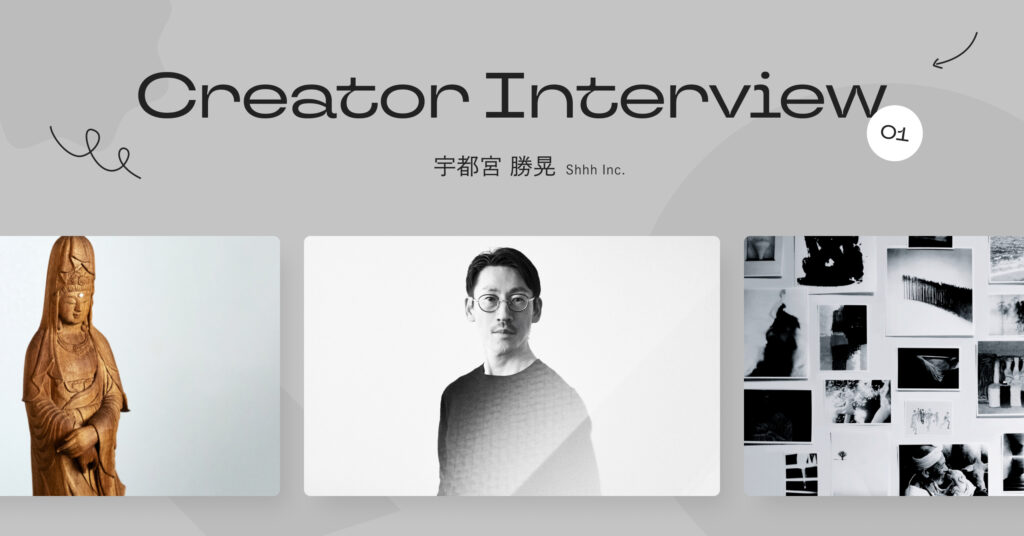
https://idid.team/articles/interview/shhh/
Utsunomiya:After the interview article was published, things suddenly started to change, and I had many new encounters, which ultimately altered the course of my own career as a designer.
For example, I gradually started to accept invitations to speak at events or give lectures, things I would have previously declined, thinking, "Someone like me isn't good enough..." Looking back now, what I realize from accumulating those experiences is that...I realized that the things I thought I was bad at, and the unexpected requests from others, were precisely where the potential for personal growth lay.That's how I see it now.
By gradually responding to the unknown, new discoveries were made.
Utsunomiya: Even things you're not good at can become surprisingly easy if you keep gaining experience, right? I think this period was about gradually expanding those things that you "can do surprisingly well once you try them." In first-time experiences, there are opportunities for you to change and your "potential strengths" lie dormant, and if you seriously confront them, a "new, different self" is surely waiting for you. I think the biggest discovery of these three years was "what comes from responding to the unknown."
Experience with projects involving "small teams" and "minimal processes" was the motivation for establishing KEI.
After those three years, Ms. Utsunomiya graduated from Shhh and went on to establish KEI. Were there any particular jobs that served as turning points for you?
Utsunomiya:I can name three projects that significantly changed my perspective as a designer and were the catalyst for my independence. Looking back, these projects have something in common:The key was having "the minimum number of project members" and "proceeding with the minimum necessary processes."
For example, before starting the design process, there are many cases where preliminary sharing takes place, such as using reference websites to coordinate ideas, creating mood boards, holding workshops, or making prototypes. However,We didn't use any such design process in these projects.
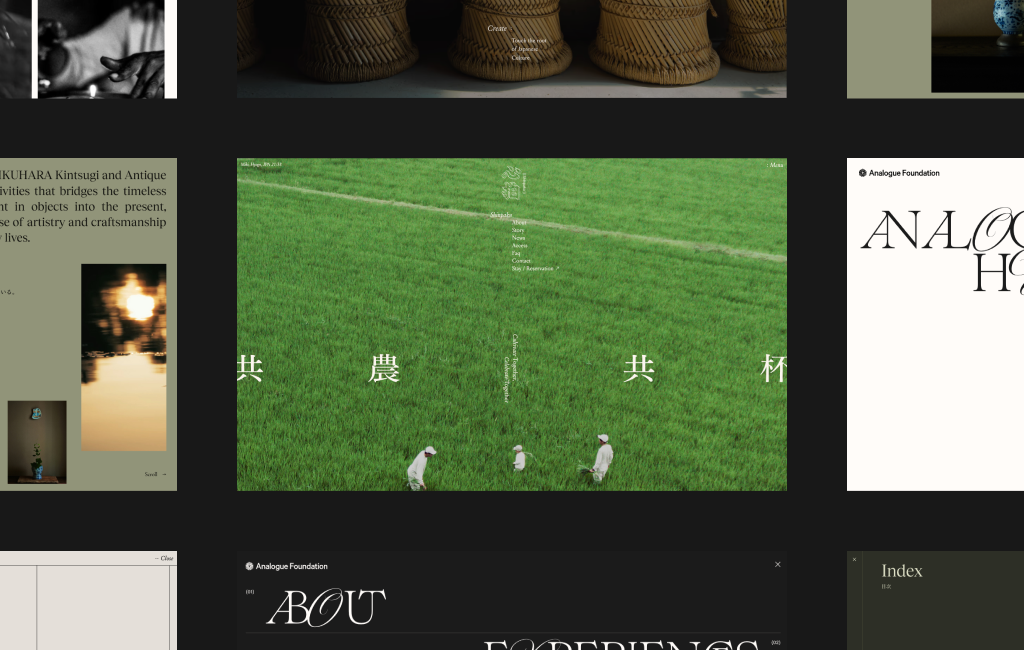
Let's discuss the three projects in more detail. First, there's 'Analog Foundation,' which was released in October 2023.
Utsunomiya:At that time, it was a "small team" project consisting of just three people: the brand general manager in charge and Shhh. And the person in charge had a very clear vision for the brand.
Seeing someone who can so clearly articulate the brand's desired image made me think."Besides design, what else do we need to do going forward?"And at the same time, I began to feel that going through all those steps was rather uncouth. Since I had already received everything from them, all I needed to do was to give back to them with all my might.
So, once we finished the basic design process, I immediately created a design and proposed it, and they loved it on the spot and agreed to it. I felt very refreshed and satisfied with this "effortlessness of the process." This project was where I discovered that this kind of "serious back-and-forth" approach to creation is really great.
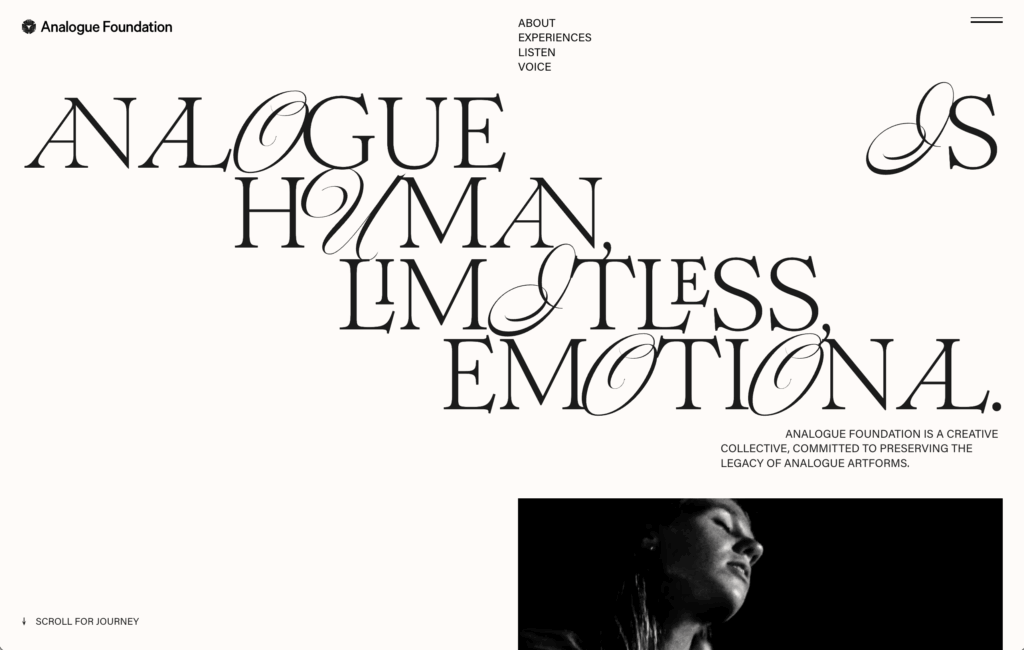
The distinctive character is constructed through "typography" and "the beauty of negative space."
https://analoguefoundation.com/ja/
This project also started by chance. Next up is 'DAIKUHARA Kintsugi and Antique', a project scheduled for release in June 2025.
Utsunomiya:DAIKUHARA's partner, who co-manages the project with the representative, Mr. Daikuhara, a kintsugi (gold repair) craftsman, really liked Shhh's corporate website and sent us a long, polite letter requesting our services. It was our first small-scale project since Analog Foundation.
DAIKUHARA is a shop that deals in kintsugi (gold repair) and antiques, and we conducted the interview after visiting their workplace in person. And here again, I felt the same thing as with Analog Foundation. They have so many words to express and a clear image of what they want to be, and they also trust in what we create. So I thought, "The best approach would be to simply return what we received."
for that reason,Similar to Analog Foundation, the process from logo creation to website design involved directly translating the words and experiences received into a design, almost like a one-shot, direct response.The projects I was working on at Shhh at the time were mostly with relatively large companies, so they were characterized by having many members involved and many processes for reaching consensus.In cases like this, "releasing the process itself" is actually the more straightforward approach.This project also served as a way to reaffirm those things.
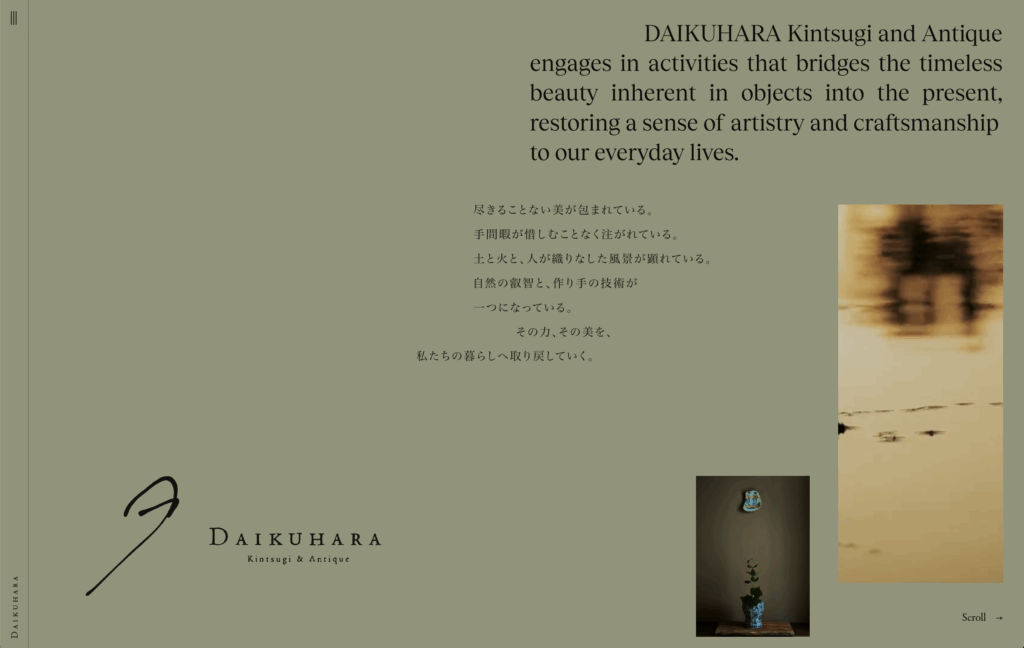
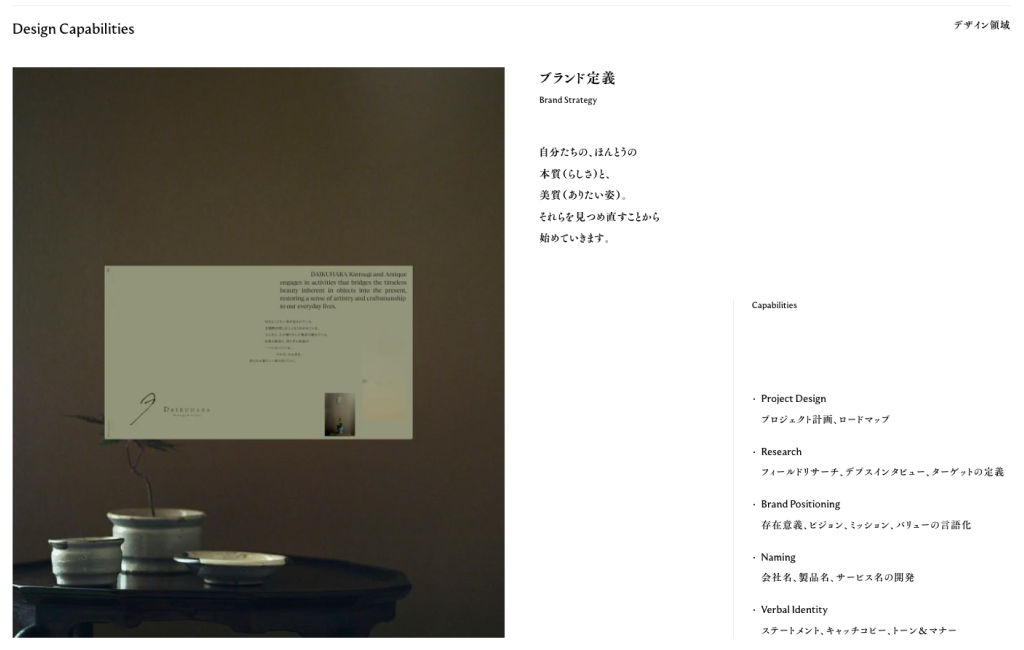
The design inherits the memory of the aesthetic sensibility that underlies the Japanese beauty that favors shadows and highlights, and the new landscape of the vessel that emerges through the kintsugi technique.
https://daikuhara.jp/
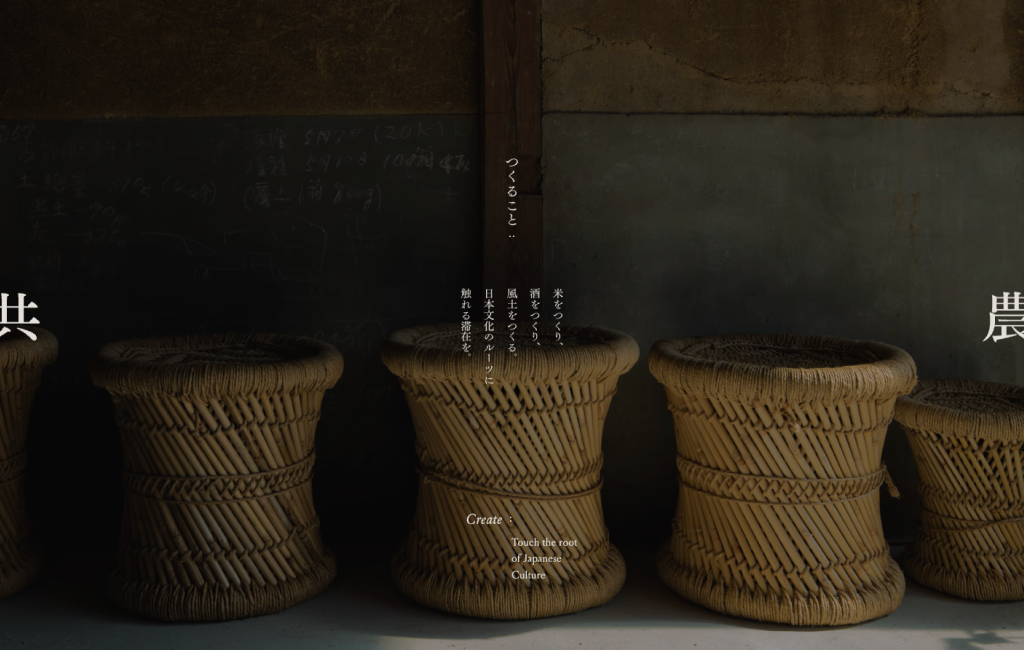
The third is "Shinpaku" (心拍). This website was launched in August 2025.
Utsunomiya: "Shinpaku" was a new project that came about when we were approached, as we already had a relationship with Magasin Co., Ltd., the company that operates Shinpaku, having created their corporate website and the website for their related project, SHUTL. As this was also a small project with just the representative, we proceeded with the same minimal process as the previous two projects, with virtually no intermediate steps other than "listening/knowing" and "creating".
By the way, when you actually show a design, you don't just show the drawing, but also explain the process and background behind it, right?
Utsunomiya:Yes, absolutely. As a prerequisite for any project, the starting point of design is to accurately grasp both "contextual understanding" and "desired state," and our proposals will be based on that. However, of these two, I place more emphasis on the "desired state." What does the company or brand want to be like in the future? That vision exists only within the representative and cannot be articulated.
That's why I place the utmost importance on interviewing the company's representatives, and I use that as a starting point for developing concepts and design ideas. For example, with Shinpaku, the representative's theme was "the coexistence of rural Japanese scenery and the highest quality," and based on what he said, I proposed a design that paid attention to typography, centering on "vast rural landscapes" that evoke a new horizon of "co-creative agriculture," and "sophistication" that can be presented to the world along with photographs that convey relationships with family, friends, and guests.
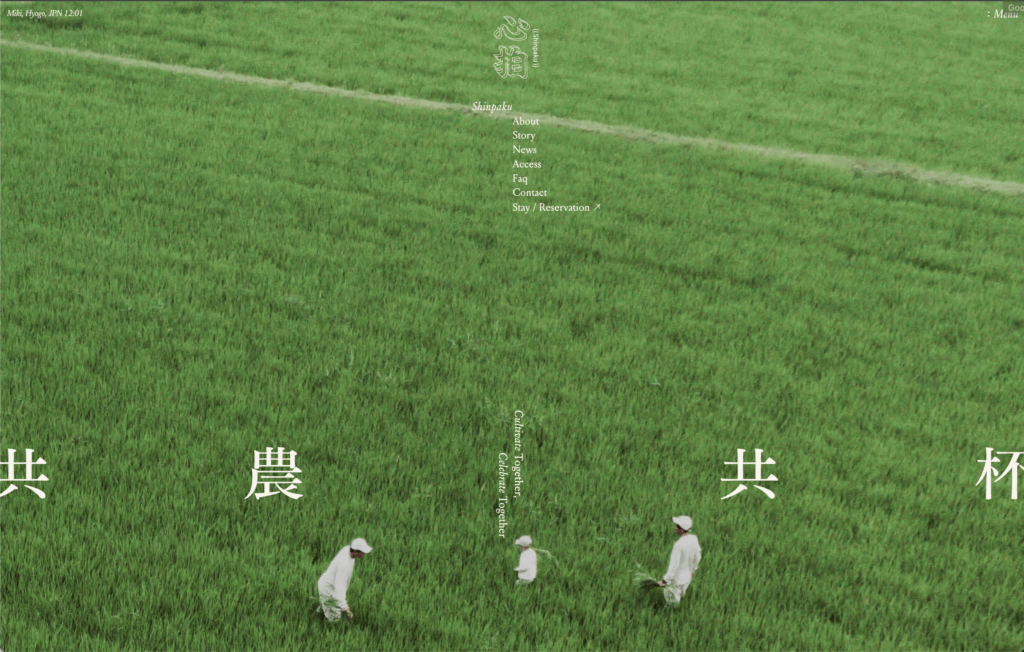
The aim was to create a site that showcases the coexistence of two opposing forces and leaves a lasting impression.
https://shinpaku.co/
Through these projects, Mr. Utsunomiya discovered the appeal of a minimalist structure and design process.
Utsunomiya: In large-scale projects with many stakeholders, a structured design process is an effective means of building consensus, but sometimes the steps in that process can seem to be a way of setting up defenses and moving towards a predetermined outcome.
The client trusts the other party and speaks. The designer listens carefully and understands what they have to say. Once that's done, all that's left is to dedicate all their efforts to realizing "the brand image the client desires" with the highest possible precision. And that's good enough, isn't it?
In that respect, the minimal process, which consists of almost a one-on-one interaction between the client and the designer, has an undeniable sense of tension and seriousness, where the only thing that matters is the quality of the content. And this tension can sometimes dramatically improve quality. For the creator, there is a certain sense of integrity, and at that moment, they feel as if they are touching the fundamental and pure essence of the act of "people creating something for other people."
Utsunomiya: And projects that proceed through such a one-on-one process tend to lead to strong work with a sense of "uniqueness." This is because the relationship itself is already unique. Conversely, I wonder if there are many things that have actually been lost in a "seemingly reproducible, democratic, and co-creative design process." I think the establishment of KEI was an extension of the idea that we want to increase opportunities to design with minimal relationships and minimal processes like this.
A New Discovery: "Design Without Output"
https://note.com/k_utsunomiya/n/n920f7132c938
I understand you've also been involved in some unique projects that are different from typical web design.
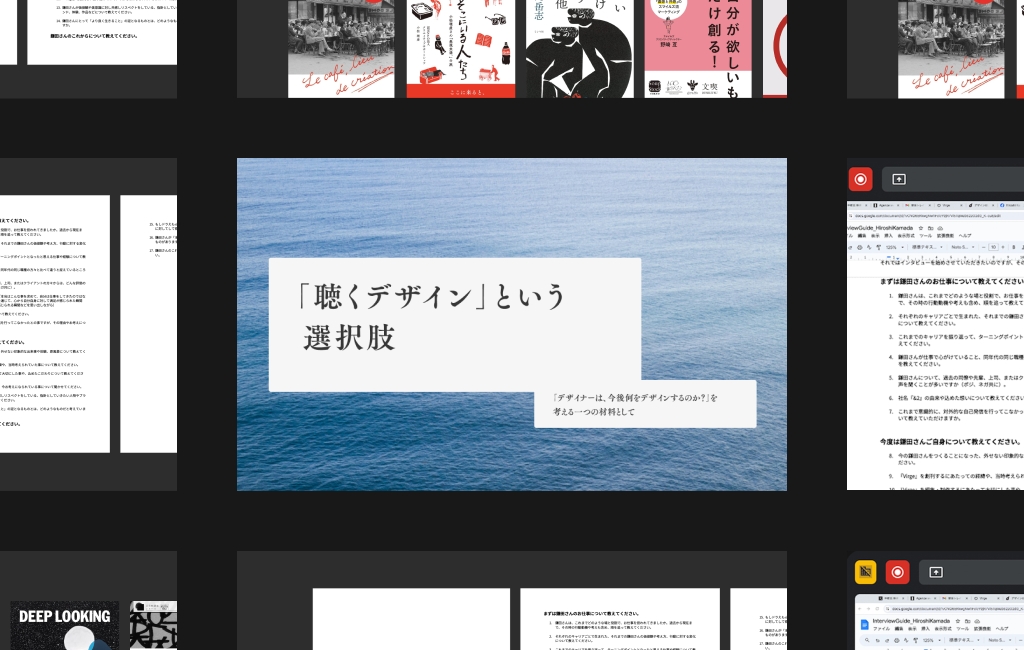
Utsunomiya: That's right. I call it "listening design," and it was a project where I conducted weekly 1.5-hour interviews with a business executive for about five months. This was also an important project that led to the current KEI.
This business owner's company has a wide range of business areas, and they were struggling to present their company effectively. After seeing my iDID interview and appearing on a podcast, they intuitively felt that "something might be discovered by talking with Mr. Utsunomiya." It was a seemingly unusual project, starting not with a request for design work, but with a desire for a dialogue.
Up until now, the interviews I've conducted for client work have always been based on the premise of producing an output such as a logo or design. But in this project, the interviews were "not required to produce an output." Just that alone drastically changed how I listened. It was an experience that allowed me to touch upon the profound depths of the act of "listening."

Utsunomiya: At the same time, I also realized that "this is the design before the 'event' even began." Here, I became convinced that if I could just listen carefully to and understand what the representative had to say, I could create a suitable expression with consistency and strength, no matter what the subject matter was. It was an important project that served as a guideline for "this is the way I should go about things from now on."
Incidentally, since the establishment of KEI, this project has actually started as a rebranding project, and is currently progressing with a scope ranging from logo design and copywriting to photography and website creation. We are still in the early stages of production, but I feel that there is a significant change in terms of strength compared to before, with each session.
What I felt in CREATIVE CLASS: the "unknownness" and "immeasurable potential" of people.
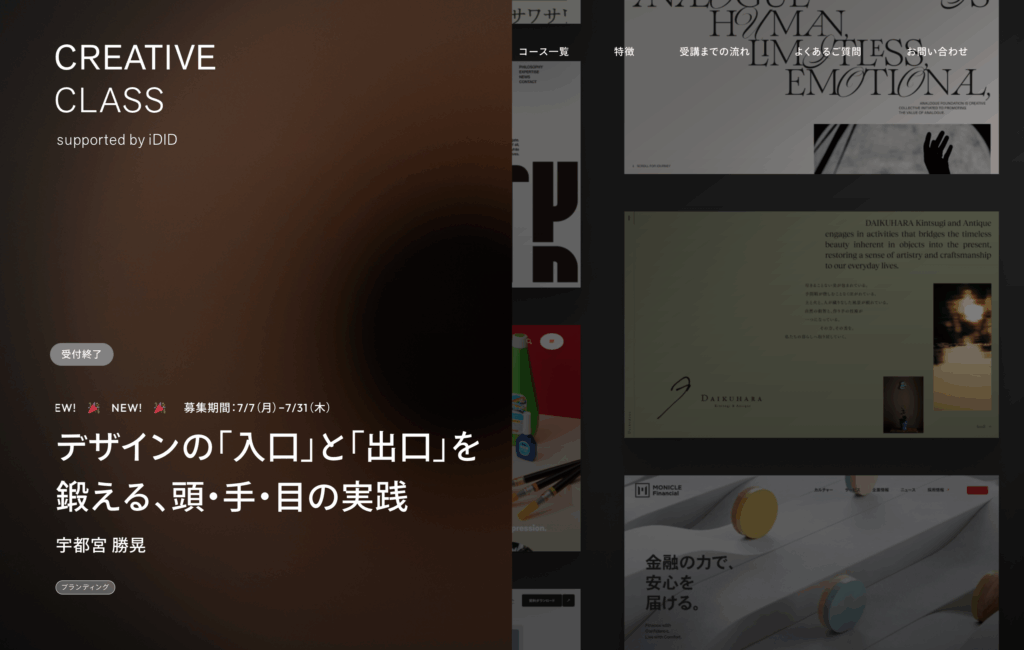
In August 2025, she also took on the role of instructor at "CREATIVE CLASS," an online school for creators. This was another new challenge for Ms. Utsunomiya.
Utsunomiya: Yes, at first I had no reason to refuse (laughs). There were leading figures in the industry scheduled to be instructors, and I, with absolutely no teaching experience, would be the first one up, so I was really worried about whether I could handle it. However, the fact that they asked me meant that they thought "this person can do it," and I thought that by taking on that challenge, I might discover a new side of myself. That was the reason I ultimately decided to do it.
After finishing the lecture, what were your own impressions and what did you gain, Ms. Utsunomiya?
Utsunomiya:One thing that has been said by many people is the realization that "teaching is the best form of learning." Through "teaching," things I thought I understood became truly understood with a sense of conviction. Even just creating a curriculum is an experience of "relearning" through the process of gathering and reconstructing all the knowledge and experience I had accumulated up to that point. It was an experience I could not have gained without this opportunity.
Another point is that "you really can't know what kind of growth or potential a person has." In CREATIVE CLASS, for each of the 10 people, there is a single theme, and each person answers with a different perspective and a different approach; it's like a "public competitive presentation by 10 people."
In competitive presentations, you usually can't see the proposals of other companies, but here, we were able to see all 10 proposals that the participants had seriously worked on at once, and also receive feedback from the instructors. As a result, I witnessed people making significant changes in just two weeks, and saw those moments firsthand.I was amazed by how much the growth curve can change depending on motivation and flexibility, and I also felt the incomprehensibility of people and the immeasurable potential that I couldn't measure with my own imagination alone.I was able to discover its appeal.
It was my first time truly engaging with the act of teaching, and what I found interesting was that the results were completely different from what I had initially expected, leading to entirely different discoveries and lessons learned.
"Personalization" and "responsibility." I believe these are the qualities that will be required of designers in the future.
https://kei-inc.jp/
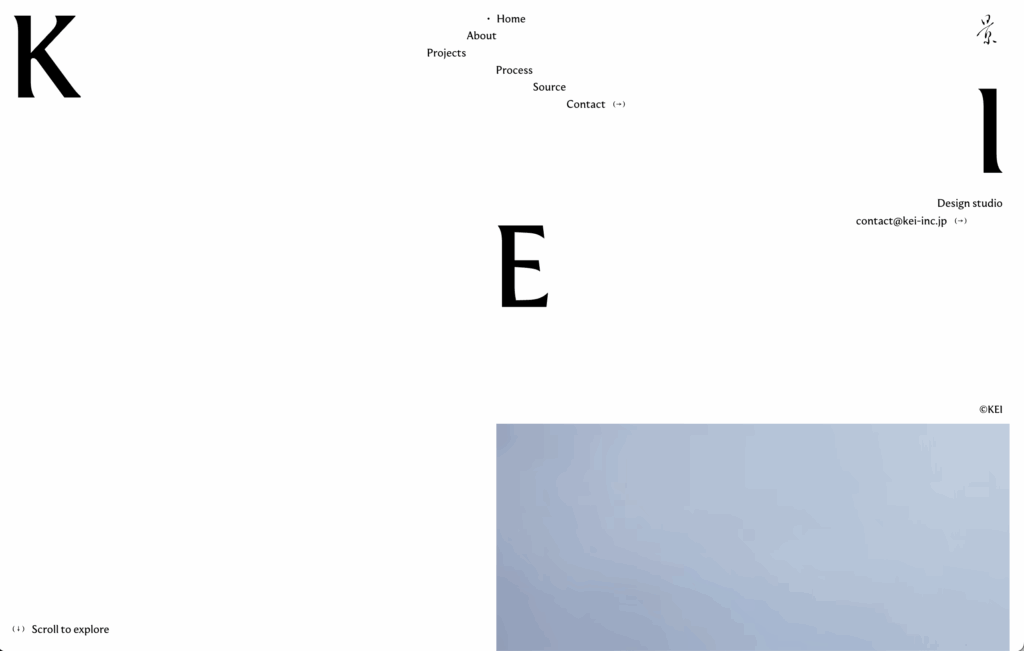
Then, in June 2026, we will establish KEI inc. Could you tell us a little more about the background to this establishment?
Utsunomiya:The reason for establishing the company is very simple: we want to increase the purity of "making" and "the things we make." Increasing the purity of "making" means letting go of the "means of a specific design process" that I mentioned earlier, and moving away from reproducibility, efficiency, and predictable harmony. This increase in the purity of "the things we make" is largely due to the environmental changes brought about by AI.
In a world overflowing with average solutions, I believe people will be increasingly drawn to the "density of inefficient biases and excesses" that average solutions cannot satisfy. Furthermore, I think that companies and brands that actually engage in such activities that transcend rationality will become the ones that possess persuasiveness, empathy, and value.
That is whyIf I want to continue being a designer, I think I need to move further away from reproducibility and step into a more personal and biased world.In other words, it's about "clearly defining what you won't do." What will you do and what won't you use your life to do? I want to be more conscious of that. I think you could say that the establishment of KEI is a manifestation of that.
On normalize.fm , Mr. Utsunomiya said that "one's own desires are important" and that "the role of a designer is to take responsibility." That is also a person's "will," and will and desire can be said to be "human qualities" that AI does not possess.
Utsunomiya: I believe that what shapes a person is "will" and "desire." So, for example, even when it comes to a design proposal, I think it's becoming more important to show your will, saying, "This is what I think." And at the same time, as an individual, you have to confront your own "desires," such as "I just can't help doing it" or "I just can't help but keep thinking about it, forgetting the time." In my case, that's simply "creating," and that background is directly connected to the establishment of KEI.
I was also struck by the statement on KEI's website: "Personality is the source of value." While this phrase is often perceived negatively, from another perspective, personality is simply another way of saying "humanity."
Utsunomiya: Yes, I believe the starting point for personalization is the recognition that "it is one of a kind in the world." For example, the randomness , scratches, and even traces of repair that appear on a vessel, which is also the origin of our company name KEI, are called "scenery" in the world of tea ceremony and pottery, and are cherished and found interesting. I think that kind of "sensitivity" is something that only humans possess.
Currently, in the context of AI, we are beginning to re-examine the meaning and significance of why we bother commissioning external designers for design work. I even wonder if the act of commissioning a designer itself will become something exclusive and limited to a select few. If that's the case, then from the perspective of the designer receiving the commission, wouldn't it be necessary to treat the company or brand as "unique"—that is, not as mere information, but as a "unique landscape with one-of-a-kindness"? I've started to think that perhaps such a worldline is something we should consider, including our own survival strategy.
The more we entrust the search for the optimal solution to AI, the more important the "meaning" and "will" that AI cannot intervene in may become as criteria for value. That is why we need to introspect on "what do I think?" and "how do I feel?" and propose ideas with conviction. In other words, the question of "who" says it, and the resolve and responsibility to clearly state "this is what I think," will become more important than ever. It might be easier to understand the nuance if we imagine the role of designer shifting towards that of a "more personal art director."
The designer's "determination" and the client's "trust in the designer in front of them."
Regarding the "process-skipping proposal" mentioned earlier, I felt that the key point was "human trust," which is different from evidence or collective intelligence, such as "I don't know if this design is the best, but I have the trust I've built with you through our dialogue. That's why I believe in this design."
Utsunomiya: If you skip the so-called process and place too much emphasis on individuality, I think outliers will inevitably occur. Whether or not you can accept that might depend on "trusting the designer in front of you." For the designer, it also comes down to a sense of commitment and responsibility when they say, "This is the most appropriate design for this project." I think that's one way in which AI and AI can play different roles.
I myself use AI in back-office operations and throughout the entire production process. While I haven't yet fully utilized it in direct design production, the quality has improved significantly in a positive way, and my time management has also changed. In that sense, I view it very positively.
For me, the words spoken by clients and the output generated by AI are all equivalent. It's good to have a diverse range of information and perspectives to take in. And on top of that, I believe that the "answer" to the question, "What do I choose, and how do I think about it?" is what brings value.
The designer's role in determining "what they think" is also part of the division of labor with AI.
Utsunomiya: There must be a lot of judgments involved in the design process. For example, a "physical judgment" like "this amount of white space feels somehow uncomfortable" is one of them. Another is the judgment of "which one to choose this time, given multiple perspectives and options." I think that these detailed "intermediate judgments" are "the points that each person should focus on," and what accumulates from these is one of the "responses" of that person's proposal.
If you stay true to your own desires, unique things will naturally emerge.
Could you tell us about your future plans and what you hope to accomplish?
Utsunomiya:Basically, I intend to continue doing the same things I've done for the past three years. I will actively take on opportunities that involve things I've never done before or things I thought I was bad at, seeing them as something interesting to explore, and I will try my best to tackle them to the best of my ability. I look forward to discovering a new version of myself through these experiences. And I'm excited to see what kind of scenery awaits me when all these different points connect.
Furthermore, instead of trying to plan things out or anticipate the future, I want to confront the part of myself that is driven by desires—things I simply can't help but think about.There is a famous quote by Coco Chanel: "Elegance is rejection."I'm using that as my personal motto, and I hope to aim for a situation where, before I know it, I'm in a place I never expected.

They are actively venturing into new areas, such as participating in the group exhibition "Ma".
"Elegance is rejection"—that's an interesting statement. What does that mean?
Utsunomiya: When we hear "elegance," we tend to think of things like "sophistication" or "elegance." But actually, if you trace its etymology, it's different; it comes from the Latin word meaning "to choose." In short, it's the accumulation of attitudes that we have chosen. It's about what I will do and what I won't do, and how I will face the world. In that sense, I want to be more conscious of clarifying my own guiding principles from now on.
Three years ago, you said you wanted to continue being a designer even when you turned 70. Could you tell us your thoughts now on design and age?
Utsunomiya: This hasn't changed from three years ago, or rather, I've started to see it as a kind of mission. For example, in the world of graphic design and architecture, there are, as a matter of course, many senior figures who have been, are, and will continue to be active on the front lines, regardless of age. However, the digital design industry has a short history, so there are inevitably fewer such figures. That's why I hope that I can become an example myself.
More recently, I've taken this meaning in a broader sense, interpreting it as, "Shouldn't everyone just live as they please at each stage of their life?" Naturally, there are changes and differences in environment, society, age, physical condition, and life stage/role. In such a context, I often feel that there's nothing more petty than creating a single, rigid image of a designer based on a set of values like "this is how it should be," or restricting people in that way.
I believe that if you stay true to your own desires—what brings you joy and happiness—unique and interesting things will naturally emerge into the world. And the more diverse those things are, the more enjoyable the world of design becomes. You yourself will also be able to live more easily. In that sense, I hope to be able to show this as one example.
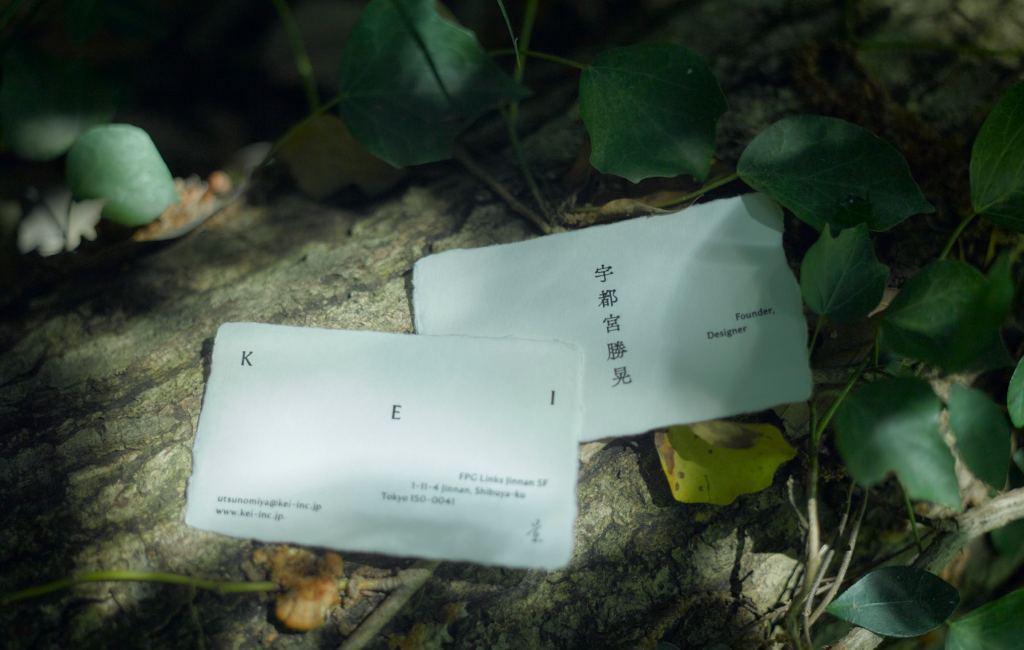
From what I've heard, it seems that what Mr. Utsunomiya is doing is beginning to go beyond the realm of design. I get the feeling that his focus is shifting to "the excitement of change."
Utsunomiya: Now that you've mentioned it, I've just thought about it for the first time, but for me, design is one means of "changing," and perhaps it's an activity for the sake of changing. For me, design is something I feel I "have no choice but to do." On the other hand, I'm interested in the "changes in my way of life" that I discover through design. I think that through design, I've become interested in "the activity of living" and "the activity of changing."
I got the impression that what Mr. Utsunomiya finds enjoyable in life is overcoming his weaknesses, trying new things, and discovering a new version of himself—in other words, continuously exploring "who I am."
Utsunomiya: I think the appeal of change lies in the fact that the more life experience you have, the more you realize how rare and precious it is. Perhaps it's precisely because it's a precious experience that we find it interesting.